
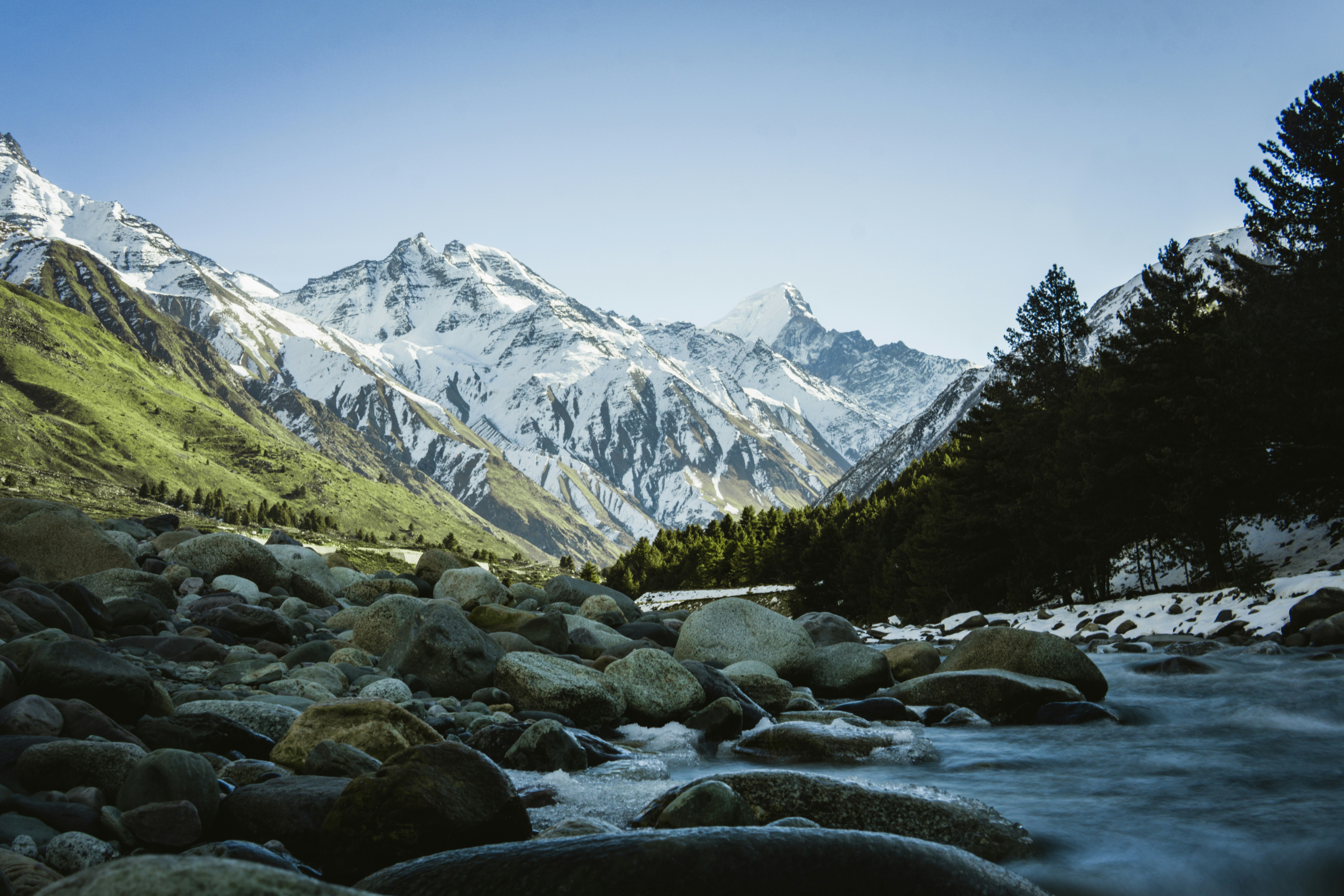

There is a moment in every great mountain journey when the landscape stops being scenery and begins to feel personal.
Perhaps it is the first glimpse of a high-altitude lake hidden between ridgelines in Kashmir, its surface so still it mirrors the sky above like a second heaven. Perhaps it is the sight of prayer flags fluttering across a wind-swept pass in Bhutan, each colour carrying a different intention into the mountain air. Or perhaps it is the silence of Ladakh, where entire valleys seem untouched by time, and you find yourself wondering whether the stillness is outside you or within you.
The Himalayas have always had this effect on people. They humble us. They challenge us. And occasionally, when we are fortunate enough to be paying attention, they change us.
1. The Old Story About Adventure Travel and Why It's Changing
For decades, trekking in India was viewed through a narrow lens. Adventure was synonymous with discomfort. The more basic the camp, the longer the drive, the rougher the logistics, the more authentic the experience was assumed to be. Hardship, somewhere along the way, became a badge of honour rather than an obstacle to be thoughtfully overcome.
That narrative is changing.
Across the world, a new generation of travellers is seeking something more intentional. They still want the mountains. They still want the challenge. They still want the quiet exhilaration of standing above the clouds after a demanding ascent, lungs burning, heart full. But they also want expertise. They want context. They want to understand what they are looking at: the geology of a glacier, the cultural significance of a monastery perched improbably on a cliff face, the name of the bird calling from the rhododendron forest below.
Most importantly, they want experiences that enrich them rather than simply exhaust them.
This shift has given rise to a new and rapidly growing category: luxury trekking, and the Himalayas are its most magnificent arena.
2. What Does Luxury Trekking Actually Mean?
The phrase can be misleading. Luxury trekking is not about replacing wilderness with comfort, or swapping a mountain trail for a resort pool. It is not about softening the experience until the adventure disappears.
Luxury trekking is about removing the unnecessary friction that prevents travellers from fully appreciating the experience.
In practice, this means exceptional leadership from guides who know these mountains intimately, not just the trails, but the history, ecology and culture woven into every altitude band. It means smaller groups, where genuine connection is possible and the mountain does not feel like a queue. It means thoughtful logistics so that the mental energy usually spent on uncertainty can instead be spent on presence. And it means deeper cultural immersion: sitting with a village elder, attending a festival that most travellers never encounter, understanding the living traditions of some of the world's most remarkable communities.
Luxury in this context is really about quality of attention, the attention paid to every detail of your journey, so that your own attention can remain where it belongs: on the mountains, the culture, the moments that matter.
3. The Juniper Outdoor Philosophy
Juniper Outdoor was not built around a product. It was built around a belief.
Our roots trace back to one of the most significant chapters in Indian mountaineering history, the legacy of Captain M. S. Kohli, who led India's first successful Everest Expedition in 1965. That expedition was not simply a sporting achievement. It was a statement about what was possible when preparation, purpose and passion aligned.
That belief remains woven into the DNA of everything Juniper Outdoor does today.
Over seven decades and across hundreds of private expeditions, we have built our reputation on a single commitment: that every journey should be worth making. Not just comfortable. Not just logistically sound. But genuinely, memorably worth it, worth the time, the distance, the miles from home. Worth the stories you will carry back with you.
This is why we work exclusively with private departures. Group dynamics matter at altitude. So do the relationships between travellers and guides, between visitors and the communities that host them. We design every journey around the people taking it, not the other way around.
4. Why the Himalayas Are the World's Greatest Luxury Adventure Destination
Few mountain ranges on earth can match the sheer diversity of the Himalayas. Within a single journey, or across a series of expeditions, travellers can move between ecosystems, cultures and landscapes that feel like entirely different worlds.
4.1 Kashmir: Alpine Beauty at Its Most Dramatic
Kashmir's Great Lakes Trek is one of India's finest high altitude routes, a journey through meadows carpeted with wildflowers, past glacial lakes that change colour with the light, across passes that reveal panoramas few travellers ever witness. Kashmir has always inspired poets, painters and wanderers. On foot, it earns every word ever written about it.
4.2 Ladakh: Silence as an Experience in Itself
Ladakh is unlike anywhere else on earth. Its high altitude desert landscape, stark, vast and impossibly beautiful, creates a quality of silence that city life rarely permits. Here, the sky feels closer. The stars at night are overwhelming. The monasteries that cling to ridgelines above ancient villages have stood for centuries, repositories of a living Buddhist tradition that continues to shape daily life. Trekking in Ladakh in winter, when the Zanskar River freezes and the famous Chadar trail becomes possible, is an experience that redefines what adventure means.
4.3 Bhutan: Spirituality, Mountains and the Trans Bhutan Trail
Bhutan is the only country in the world that measures its prosperity in happiness rather than output, and that philosophy permeates every aspect of life here. The recently revived Trans Bhutan Trail, a 400 kilometre ancient route connecting the kingdom from east to west, offers an extraordinary journey through dzongs, rice terraces, pine forests and alpine meadows. Trekking in Bhutan is as much a cultural pilgrimage as a physical one.
4.4 Nepal: The World's Trekking Capital
From the Annapurna Circuit to the Everest Base Camp trail, Nepal offers routes that have defined adventure travel for generations. But beyond the famous names lie quieter valleys, less travelled passes and Sherpa communities whose warmth and resilience are as remarkable as the mountains above them. Nepal rewards those who travel slowly and attentively.
4.5 Northeast India: The Himalayas' Hidden Chapter
Arunachal Pradesh, Nagaland and Sikkim represent some of the most biodiverse and culturally rich corners of the subcontinent, and some of the least visited. Rainforest landscapes, tribal traditions, extraordinary biodiversity and Himalayan foothills that feel genuinely undiscovered make Northeast India one of the great frontiers for thoughtful adventure travel.
5. The Rise of Active Luxury Travel
The global travel industry is undergoing a fundamental shift. Wellness travel, experiential tourism and active holidays are no longer niche categories. They are among the fastest growing segments in luxury travel worldwide.
Travellers who once measured a great holiday by the quality of a hotel room are now measuring it by the quality of an experience. Did it stretch them? Did it teach them something? Did it connect them to a place and its people in a way that felt genuine?
Luxury trekking sits precisely at the intersection of these values. It is physical without being punishing. It is cultural without being superficial. It is adventurous without being reckless. And in the Himalayas, where every valley holds a different civilisation and every altitude a different ecosystem, it offers a depth of experience that very few other forms of travel can match.
6. What to Expect on a Juniper Outdoor Expedition
Every Juniper journey begins long before the first step on the trail. Our pre-departure process includes detailed consultations to understand your interests, fitness level, pace preferences and what you most hope to take away from the experience. We then design a journey specifically around those answers.
On the ground, you travel with guides who are not just qualified. They are passionate. People who have spent their lives in these mountains and consider it a privilege to share them. Camps are chosen for location as much as comfort: the right view at the right altitude, with enough space to breathe and enough warmth to sleep well.
We maintain small group sizes by design. This is not a cost measure. It is a quality measure. Smaller groups move more quietly through landscapes and communities. They create conditions for genuine conversation, genuine encounter, genuine experience.
And because we work exclusively on private departures, every element of the journey, from the pace to the programme to the cuisine, is shaped entirely around you.
7. The Mountains Are Waiting
There is a reason people return from the Himalayas different from when they left. The scale of the landscape does something to perspective. The physical demands of high altitude travel do something to presence. The encounter with cultures whose relationship with the natural world is ancient and unbroken does something to understanding.
The question is not whether the Himalayas will change you.
The question is whether you are ready to let them.
Juniper Outdoor has been curating private Himalayan expeditions for over seven decades. We would be honoured to begin planning yours.